
The Scorpion Search
The Wisdom of CrowdsThis character-centered thread follows John Craven’s effort to turn scattered, uncertain judgments into a successful search estimate.
increasing Bearing strength in each event
 decreasing
Bearing strength in each eventdecreasingA Submarine Vanishes
An Unbounded Search
Missing Contact
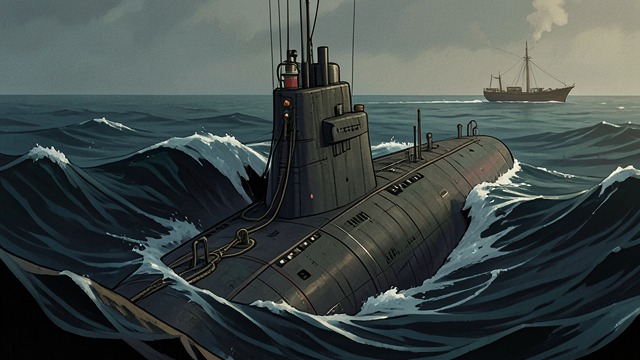
The USS Scorpion disappeared while returning to Newport News after duty in the North Atlantic. The navy knew its last reported position but had little certainty about what happened or how far the submarine had traveled.
The search area stretched across a wide circle and descended thousands of feet beneath the sea. Finding the vessel by simply searching everywhere would be an almost hopeless task.
The Expert-Only Temptation
A conventional response might have been to consult a few senior submarine specialists and search where they pointed. John Craven instead treated uncertainty as something to divide into smaller judgments.
The crisis sets the stakes for his method: no single person could supply a complete account, but many people might each hold a useful fragment.
Scenarios and Wagers
Betting on Possibilities
A Mixed Team
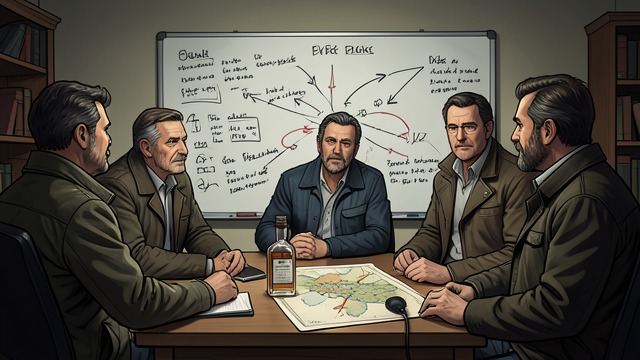
Craven assembled mathematicians, submarine specialists, and salvage workers. He devised alternative scenarios and asked each participant to estimate likelihoods separately instead of having them negotiate a shared answer.
The questions concerned elements such as the cause of the trouble, the submarine’s speed, and the steepness of its descent. Bottles of Chivas Regal supplied a playful wager, but the judgments addressed a grave problem.
Independence by Design
Keeping the guesses separate helped preserve differences among the participants’ knowledge and intuitions. Their responses were not a finished map; they were inputs to a composite estimate.
Craven’s design made aggregation the central task, replacing the expectation that discussion would naturally reveal one expert’s answer.
Bayes Builds a Location
Combining Uncertainty
Updating Expectations
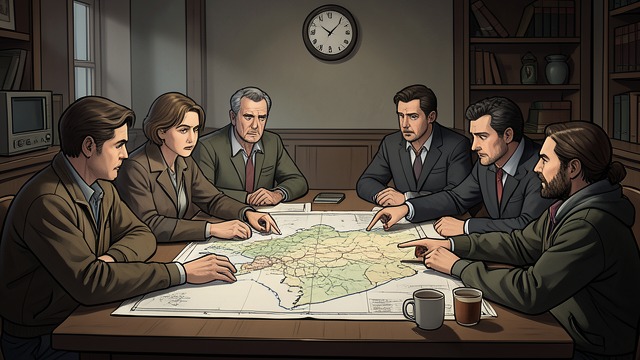
Craven used Bayes’s theorem to combine the wagers. The calculation treated each judgment as evidence that could change the relative likelihood of different explanations and locations.
The resulting picture did not match any participant’s private mental model. Its force came from combining estimates that were incomplete on their own.
A Collective Answer
Craven’s method did not make the uncertain facts certain. It turned several uncertain pieces into a coherent estimate that could guide an expensive search.
The result illustrates the distinction between a group discussion and an aggregated judgment: the answer belonged to the process as a whole, not to its most authoritative voice.
Search Near the Estimate
Testing the Composite Picture
A Target in the Ocean
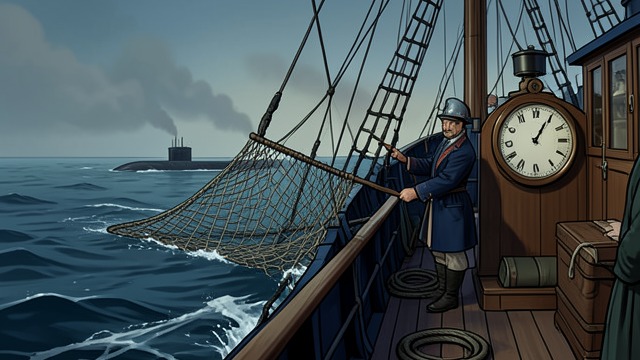
The navy faced an enormous search problem, but Craven’s estimate identified a more specific location. It offered a reason to focus resources rather than treat every point in the search area as equally promising.
The search still depended on ships, instruments, and time. A persuasive calculation was not itself the discovery; it was a way to make the search more directed.
Collective Knowledge in Practice
The episode embodies the book’s claim that a group can know more than any member, even when each contribution is only a small scrap of evidence.
Its significance lies in process as much as outcome: diverse participants made independent estimates, and a mechanism combined them into a testable prediction.
The Submarine Found
A Close Prediction
Confirmation at Sea
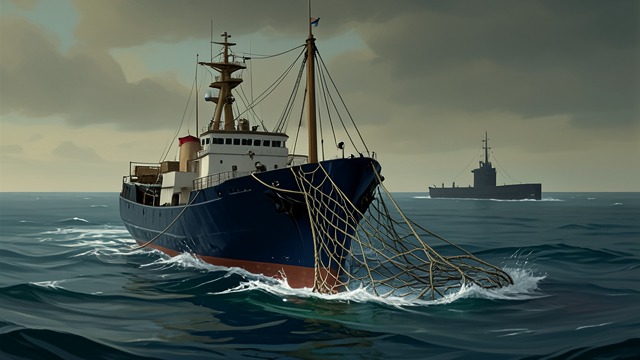
Five months after the disappearance, a navy ship found the USS Scorpion about 220 yards from the position Craven’s group had estimated.
No member had independently predicted that exact location. The group’s judgment proved remarkably close despite the uncertainty surrounding the submarine’s failure and descent.
An Argument Made Concrete
The discovery gives the introduction a dramatic resolution: a collective estimate had guided a search through a vast area to a nearly exact point.
It does not establish that every crowd is wise. Instead, it demonstrates the power of a carefully constructed group whose differences are preserved and whose judgments are combined.
May 1968
After the submarine disappeared in May 1968
During the Scorpion search in 1968
The months following May 1968
October 1968
